05/14/2025/
1 Comment
5 Costly Car Repairs You Can Avoid with Regular Maintenance Auto Nation Services 05/14/2025 1:30 pm 5 Costly Car Repairs...
A little vibration from a running engine is normal. But when a car that once felt smooth begins sending a new vibration through the steering wheel, seat or cabin—or starts making a clunk when accelerating or selecting a gear—it deserves attention.
One component drivers often overlook is the engine mount. Engine and transmission mounts secure the powertrain while helping isolate the vibration it naturally produces. When a mount becomes worn, cracked, collapsed or damaged, more of that movement can be transferred into the vehicle.
The difficulty is that vibration is not a diagnosis. Engine-running faults, drivetrain issues and other mechanical problems can create similar symptoms. The useful question is not simply, “Do I need an engine mount?” It is, “What is causing this new vibration or movement?”
For drivers across Ras Al Khaimah—including Al Hamra, Al Marjan Island, Mina Al Arab, Al Dhait and nearby communities—this guide explains the warning signs, what mounts actually do, and when a professional inspection makes sense.
An engine produces vibration whenever it runs and moves slightly as torque changes during acceleration and deceleration. The mounting system is designed to keep that movement controlled while isolating much of the vibration from the vehicle body.
Secure the engine and transmission to the vehicle
Control excessive powertrain movement
Absorb and isolate vibration
Support smoother, quieter cabin behaviour
Help maintain correct powertrain positioning
Vehicles may use conventional rubber mounts, hydraulic mounts or more sophisticated electronically controlled designs. Transmission mounts—often called gearbox or gear mounts—perform a similar stabilising role for the transmission.
One of the most noticeable symptoms is a new or stronger vibration while the vehicle is stationary and the engine is running. It may be felt through the steering wheel, seats, dashboard, floor or centre console. In some vehicles it becomes more obvious when Drive is selected or when the A/C compressor adds load. This symptom still needs diagnosis: ignition, engine-performance and other mechanical faults can feel similar.
A damaged mount can allow more movement than intended. Under acceleration, braking or a sudden change in load, that movement may be heard or felt as a clunk, knock or thud. A new mechanical sound during these transitions is worth inspecting rather than guessing at the cause.
Some engine movement is normal. Excessive movement is not. A deteriorated or separated mount can allow the powertrain to shift more than designed when torque is applied. A technician can inspect the mounting points and assess whether movement is abnormal.
Transmission mounts also control powertrain movement. A worn mount may contribute to a noticeable thud, vibration or movement when shifting between Park, Reverse and Drive, or during changes in drivetrain load. Harsh shifting can also originate elsewhere in the transmission or drivetrain, so this symptom should not be used as a stand-alone diagnosis.
Mounts are not only structural components; they also help isolate vibration from occupants. As that isolation deteriorates, a vehicle may suddenly feel less refined. This can be especially noticeable in premium sedans and SUVs where drivers are accustomed to a quiet, smooth cabin.
Excessive powertrain movement can sometimes allow components to move farther than intended. Knocking or impact-type sounds may appear during start-up, acceleration, braking, gear selection or movement over uneven surfaces. Several engine, drivetrain and suspension components can produce similar noises, so the location and conditions of the sound matter.
Sometimes deterioration can be seen during a physical inspection. Depending on the mount design, a technician may look for cracked rubber, separation, collapsed sections, damaged brackets or leakage from a hydraulic mount. Visual condition is one part of diagnosis; it should be considered together with the vehicle’s symptoms and powertrain movement.
Mounts are wear components, but there is no single replacement mileage that applies to every car. Their condition is influenced by vehicle design, age, mileage, heat cycles, contamination from oil or other fluids, repeated powertrain movement and the condition of surrounding components.
For that reason, condition and symptoms matter more than replacing mounts simply because a vehicle has crossed an arbitrary mileage.
Vehicles in the UAE operate in a demanding thermal environment. Engine bays are already hot during normal operation, and high ambient temperatures add to the heat exposure experienced by rubber, plastic and fluid-filled components. That does not mean UAE heat is the sole cause of every failed mount; age, design, mileage, contamination and operating conditions also matter.
For Ras Al Khaimah drivers, the practical lesson is simple: when a vehicle develops a new vibration, noise or change in refinement, have the cause inspected instead of assuming it is normal wear.
A deteriorated mount is not only a comfort issue. If powertrain movement becomes excessive, it can place additional stress on nearby hoses, wiring, exhaust connections or other components, depending on the vehicle and severity of the fault.
There is another reason not to ignore the symptom: the vibration or knocking may be coming from something else entirely. A proper diagnosis can separate a mounting problem from an engine-running, transmission, suspension or drivetrain issue.
A useful diagnosis should involve more than looking at the car and immediately recommending parts. Depending on the vehicle and symptoms, the inspection may include:
If the concern involves a wider mechanical issue, read more about professional car mechanical repair in Ras Al Khaimah. For engine-specific warning signs and deeper repairs, see our engine repair and diagnostics service.
A recent Lexus ES 350 at Auto Nation Services required several mechanical repairs, including engine mounting replacement, gear mounting replacement, idler replacement and sensor replacement. The vehicle was inspected and the required components were replaced as part of the mechanical repair work.
The useful lesson is not that every Lexus vibration needs the same parts. It is the opposite: a vehicle should be treated as a complete mechanical system. Symptoms need to be inspected, the cause identified, and only the components that actually require attention should be repaired or replaced.
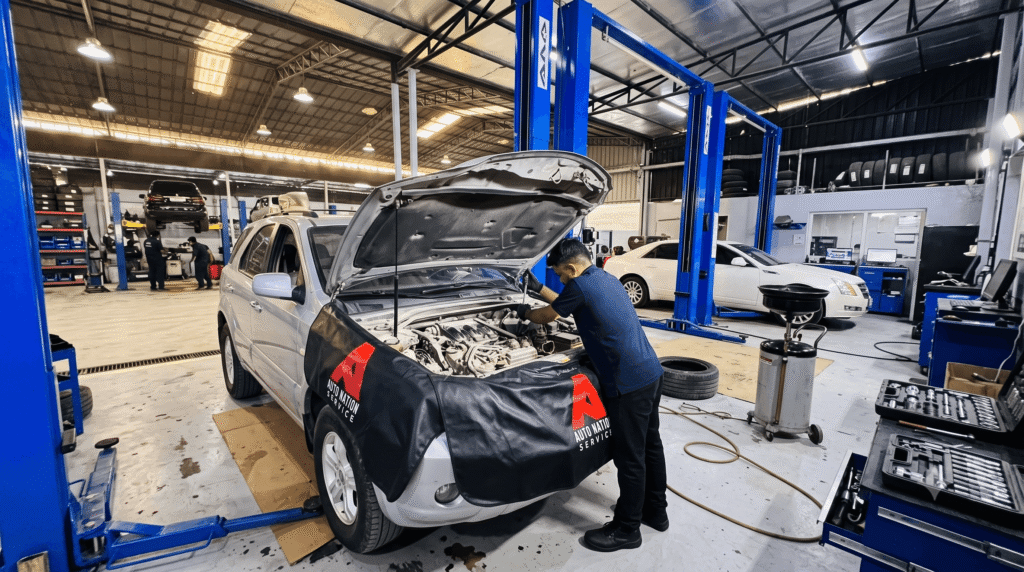
Mounting systems differ between manufacturers and models, but wear can occur across Japanese, European and American vehicles. Auto Nation Services works on multiple brands, including Lexus, Toyota, Nissan, BMW, Mercedes-Benz, Porsche, Range Rover, Chevrolet and others.
The brand badge is not the diagnosis. The vehicle’s specific symptoms, design and condition should guide the inspection.
Consider arranging an inspection if you notice:
Do not automatically assume the mount needs replacement. The first objective should be to identify the source of the symptom.
Engine mounts are only one part of a vehicle’s mechanical health. For a broader preventive-maintenance framework, see our Complete Car Maintenance Guide for Ras Al Khaimah Drivers.
If the vibration is accompanied by smoke, abnormal oil consumption or deeper engine symptoms, our BMW oil consumption and white-smoke guide is an example of why early warning signs should be investigated rather than ignored.
If your vehicle has developed unusual vibration, knocking or excessive engine movement, Auto Nation Services can inspect the vehicle and determine the cause before recommending repairs.
Our multi-brand workshop provides mechanical repair, diagnostics and vehicle maintenance in Ras Al Khaimah, serving drivers from Al Hamra, Al Marjan Island, Mina Al Arab, Al Dhait and surrounding RAK communities.
Auto Nation Services – Ras Al Khaimah
+971 54 214 1200
View all Auto Nation Services
A vehicle may still be driveable with a deteriorating mount, but severity varies. Strong vibration, knocking or excessive engine movement should be inspected rather than treated as normal.
Yes. Isolating engine vibration is one of their functions. When a mount deteriorates, more vibration may be transferred into the vehicle. Other mechanical and engine-running faults can also cause vibration.
Selecting Drive changes the load on the powertrain. A deteriorated mount can sometimes make vibration more noticeable, but other faults can create the same symptom.
It can contribute to excessive movement and clunking during changes in drivetrain load. Transmission and drivetrain faults can also cause clunks, so inspection is important.
There is no universal replacement interval. Service life depends on design, age, mileage, operating conditions, heat exposure and contamination. Condition should guide replacement.
Not necessarily. The complete mounting system should be inspected, and replacement should be based on the condition of the individual mounts and the vehicle manufacturer’s repair guidance.
It can be difficult to tell without inspection because engine-running faults, mounts, transmission components and other mechanical issues can create overlapping symptoms. Diagnosis should identify the source before parts are replaced.
5 Costly Car Repairs You Can Avoid with Regular Maintenance Auto Nation Services 05/14/2025 1:30 pm 5 Costly Car Repairs...

Essential Tips to Prevent Car Battery Drain in the UAE Summer Heat Auto Nation Services 08/08/2024 12:29 pm Essential Tips...

Why Choose Auto Nation Services for Top-Notch Auto Care? Auto Nation Services 06/11/2024 5:39 pm Welcome to Auto Nation Services,...